
 Curtain Motors
 Controls
 Tubular Engines
 Venetian Blind Motors
 Vertical Engines
 Vertical Apparatus
 Fabric Curtain Spare Part
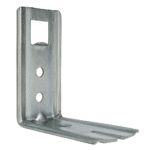 Folding Curtain Square Shaft Spare Parts
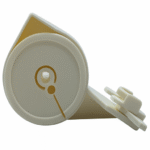 Folding Curtain Hexagonal Shaft Spare Parts
 Bamboo Roller Blind Spare Parts
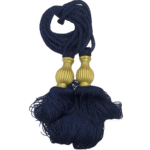 Fabric Curtain Accessories
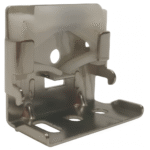 Jalousie Spare Part
 Wooden Venetian Blind Spare Parts
 Aluminum Venetian Blind Spare Parts
 Roller Blind Spare Part
 16 Mini Machine Spare Parts
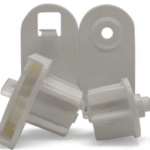 32 Mechanism Spare Parts
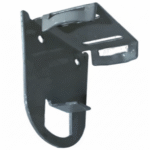 38 Mechanism Spare Parts
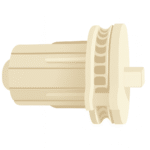 Motorized Curtain Spare Parts
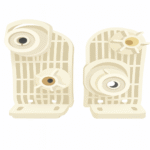 Double System Spare Parts
 Curtain General Spare Parts
 Vertical Curtain Spare Part
 PVC Vertical Blinds Spare Parts
 Fabric Vertical Blind Spare Parts
 Japanese Curtain Spare Parts
 Wooden Curtains
 Aluminum Jalousie Curtains
 Polyester Roller Blinds
 Blackout Roller Blinds
 Screen Roller Blinds
 Fabric Vertical Curtains
 Tulle Vertical Blinds
 Backdrop Curtains
 Pillow
 Tulle Curtains






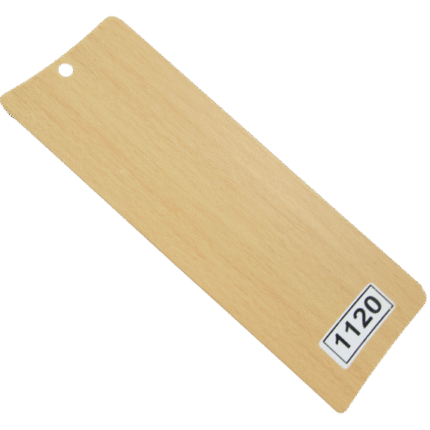
General Features of PVC Vertical Blinds
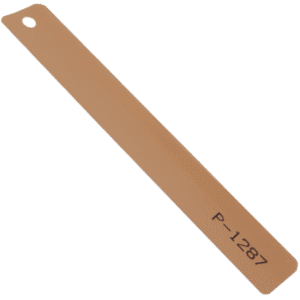
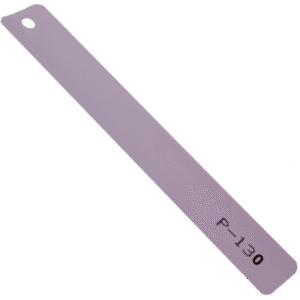
Slats made of PVC with a width of 89 mm rotate 180º around their own axis via a mechanical control chain to control light. Additionally, depending on the installation location, they can be drawn mechanically with a cord to the right, left, from the center to both sides, or from the edge to the center, creating an aesthetic and ergonomic environment. The general appearance of Double-Striped, Ribbed, Perforated, Wood-Look, and Plain PVC vertical blinds is as shown in Figure-1.
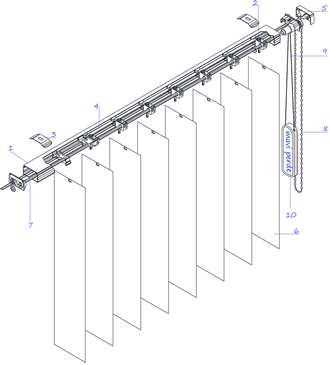 |
1. Headrail 2. Carrier (wagon) 3. Clip (portray) 4. Carrier Link (spacer) 5. Control Unit (head set) 6. Slat 7. Tilt Rod (tilt) 8. Mechanical Direction Control Chain 9. Mechanical Draw Cord 10. Bottom Weight |
 |
| FABRIC VERTICAL | PVC VERTICAL | ALUMINUM VERTICAL | WOOD VERTICAL | |
| Maximum Width | 500 cm | 500 cm | 500 cm | 500 cm |
| Minimum Width | 20 cm | 20 cm | 20 cm | 20 cm |
| Maximum Height | 400 cm | 500 cm | 250 cm | 500 cm |
| Minimum Height | 20 cm | 20 cm | 20 cm | 20 cm |
| Maximum Area | 20 m² | 25 m² | 12.5 m² | 25 m² |
| Minimum Area | 0.1 m² | 0.1 m² | 0.1 m² | 0.1 m² |
| Headrail Color | White | White | White | White |
| Open Control | Cord | Cord | Cord | Cord |
| Tilt Control | Chain | Chain | Chain | Chain |
Vertical Blind Installation
Headrail
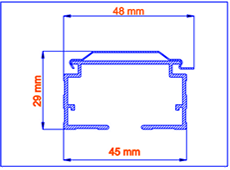 |
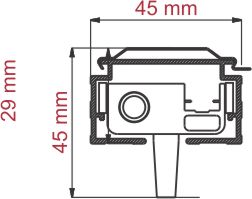
The Fabric Vertical Blind headrail, manufactured from aluminum profile, is 6 meters long and is cut to size during production. As shown in Figure 2, the carriers that hold the slats move along the tracks inside the aluminum headrail. The carriers are connected to each other with links (spacer) that allow extension by the width of a slat. A star-shaped aluminum tilt rod passes through the center of the carriers. Rotated by the chain, the tilt rod enables the slats to rotate 180°. The cords passing through the carriers and making a full turn allow the blind to open and close. |
Number of Clips, Number of Slats, and Stack Distance for Vertical Blinds
| 89 mm | Single Draw | Double Draw | |||
| Width | Number of Clips | Slats | Stack | Slats | Stack |
| 100 cm | 2 | 13 | 14.3 | 7.7+7.7 | 13 |
| 140 cm | 2 | 18 | 19.8 | 9.9+9.9 | 19 |
| 180 cm | 3 | 23 | 25.3 | 13.2+13.2 | 23 |
| 220 cm | 3 | 29 | 31.9 | 16.5+16.5 | 29 |
| 260 cm | 4 | 34 | 37.4 | 18.7+18.7 | 35 |
| 300 cm | 4 | 39 | 42.9 | 22.0+22.0 | 39 |
| 340 cm | 4 | 44 | 48.4 | 24.2+24.2 | 49 |
| 380 cm | 5 | 49 | 53.9 | 27.5+27.5 | 49 |
| 420 cm | 5 | 54 | 59.4 | 29.7+29.7 | 55 |
| 460 cm | 6 | 59 | 64.9 | 33.0+33.0 | 59 |
| 500 cm | 6 | 64 | 70.4 | 35.2+35.2 | 65 |
| 540 cm | 6 | 69 | 75.9 | 38.5+38.5 | 69 |
| 580 cm | 6 | 74 | 81.4 | 40.7+40.7 | 75 |
Vertical Blind Stacking Direction
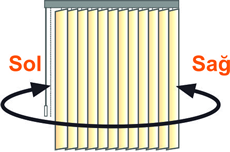
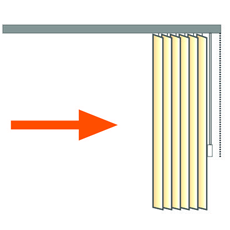
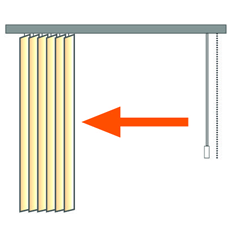
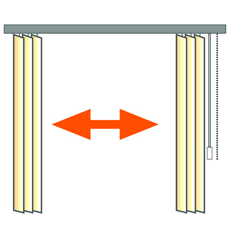
The control types should be selected according to the installation location of the vertical blind. When choosing, pay attention to the opening directions of doors and windows.
 |
 |
 |
 |
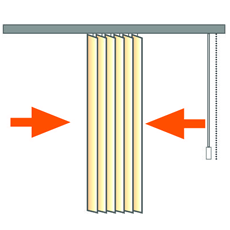 |
| In single-draw vertical blind mechanisms, you can set the control side (chain and cord) to the right or left during installation. It must be set during production for sloped and motorized versions. | The stacking direction to the right or left is determined during installation. Here you decide whether the stacking is on the control mechanism side or the opposite side. The aim is ease of use. | The stacking direction to the right or left is determined during installation. Here you decide whether the stacking is on the control mechanism side or the opposite side. The aim is ease of use. | The stacking direction to the right or left is determined during installation. Here, the vertical blind slats open from the center to both sides. Splitting from the center prevents excessive build-up of slats in large blinds, improves aesthetics, and increases durability. | The stacking direction to the right or left is determined during installation. Here, stacking occurs from both edges toward the center. This is to eliminate issues caused by opening windows or doors. |
Height of the Control System (Chain and Cord)
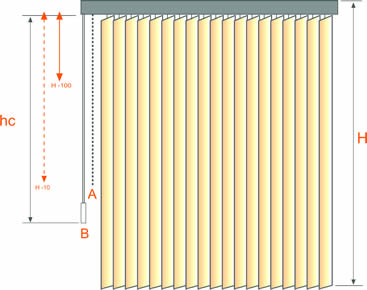
If we denote the blind height as H and the control system height as Hc: if H is below 220 cm, make Hc 10 cm shorter than the blind height. If H is 221 cm or higher, make the control system 100 cm shorter than the blind height.
 |
|
Note: If the measurements you provide do not match the values in the table, Maviperde will manufacture according to the table values.
Measuring for Vertical Blinds
 |
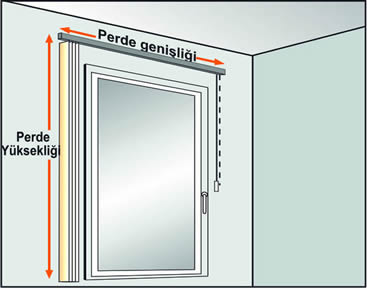 |
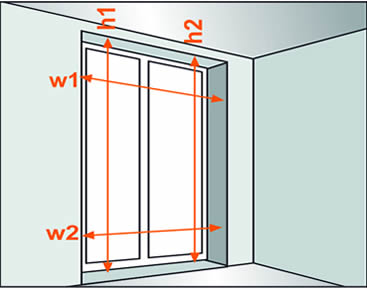
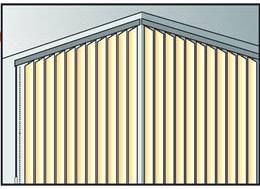
| Width (w1, w2) and height (H1 and H2) should be measured from two different points. The measurement to be used (g and h) is the smaller one in both cases. For inside-recess measurements, subtract 1 cm from the width for installation ease and 2 cm from the height to prevent rubbing on the floor or wall when ordering. | When measuring for wall or ceiling installation, consider the stacking measurements and leave at least 15 cm from the edges. Determine the control side by considering the opening direction and handles of the window or door. |
 |
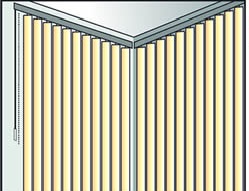 |
| When measuring for outside, angled spaces, ensure the headrails align perfectly with each other. | When measuring for inside corners, calculate the blind widths and order accordingly. |
Vertical Blind Production Models
1) SLOPED HEADRAIL MODEL
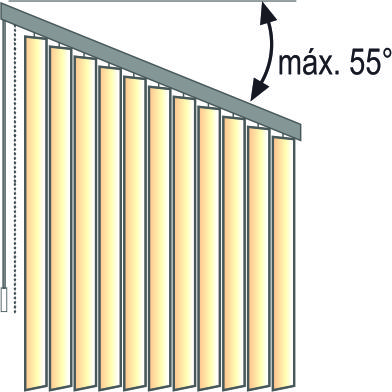 |
When ordering a sloped vertical blind from Maviperde, please consider the information below and be sure to send a detailed drawing accordingly. A slope up to a maximum of 550 can be applied. Stacking is only toward the higher side. A wall bracket can be supplied to keep the vertical blind steady in the middle. Maximum width cannot exceed 4 m. |
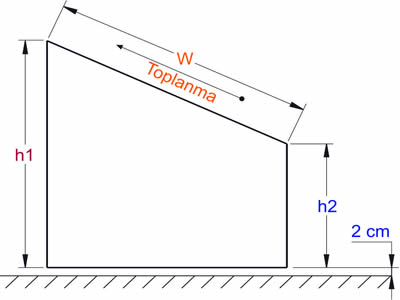 |
L: Maximum blind width
h1: Maximum blind height h2: Minimum blind height |
2) SLOPED SLAT MODEL
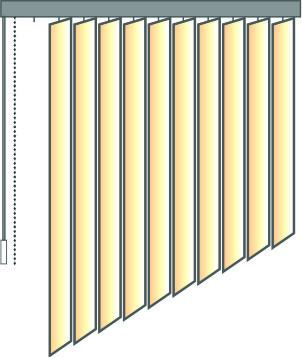 |
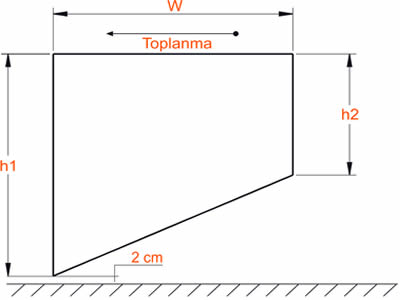 |
|
| If the slope is not in the headrail but at the bottom, the slatted blind can be stacked toward the longer slat side. | w: Maximum blind width
h1: Maximum blind height h2: Minimum blind height |
3) STEPPED SLOPED SLAT MODEL This system is applied to stepped areas: while the headrail is mounted parallel to the floor or wall, the slats are cut at an angle according to the step dimensions. In this system, stacking is toward the longer slat side.
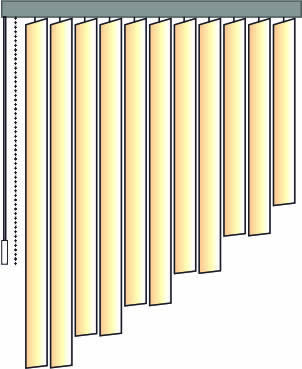 |
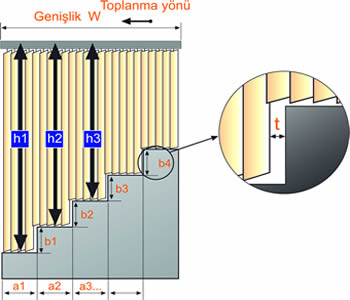 |
w: Blind width
h1, h2, h3: Step width b1, b2, b3: Step height Tolerance between blind and step (t) is 0.72 mm. |
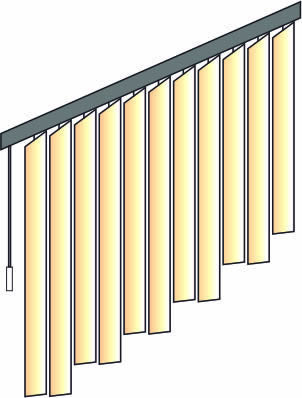
4) SLOPED HEADRAIL & STEPPED SLOPED SLAT MODEL
In this system, the headrail is sloped and the bottoms of the slats must be adapted to the stairs. This system does not allow the blind to open; you can only tilt left-right to adjust light.
 |
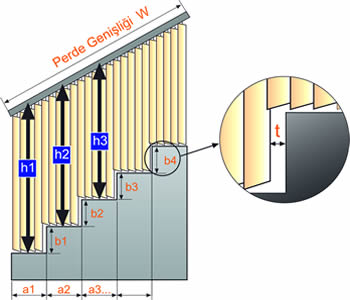 |
| w: Blind width h1, h2, h3: Height a1, a2, a3: Step width b1, b2, b3: Step height |
Tolerance between blind and step (t) is 0.72 mm. |
5) MULTI-COLORED SLAT MODEL
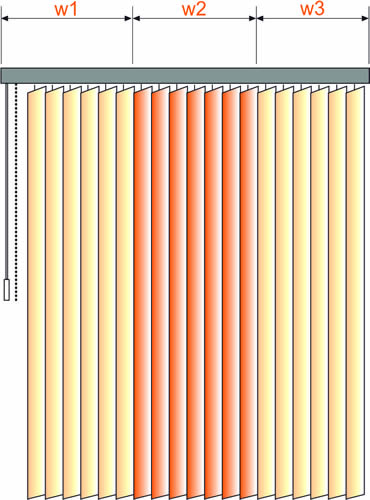
Use slats in different colors to create various combinations.
w1, w2, w3… indicate the width of each color. During production, the inter-color transition tolerance is 75 mm.
6) TRUNCATED SLAT MODEL
This type of vertical blind is used for tilt-and-turn doors and windows.
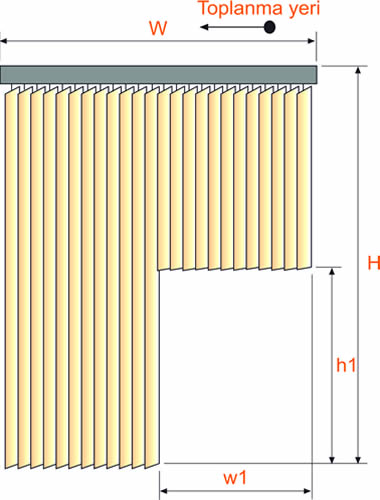 |
W: Blind width H: Blind height W1: Width of the slat to be cut H1: Height of the slat to be cut Width tolerance of the slat to be cut (t) is 0.72 mm. |
7) MOTORIZED VERTICAL BLIND MODEL
The motorized vertical blind provides slat tilting and stacking.
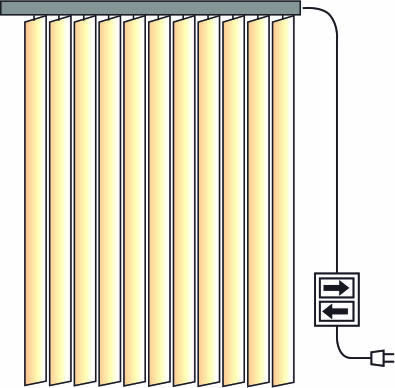
MOTOR POSITION
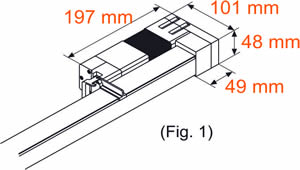
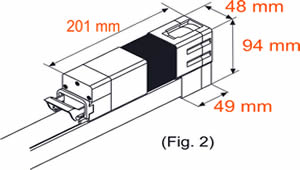
The motor can be mounted on the vertical blind in two ways.
| a – Horizontal motor position (Fig.1) | b – Vertical motor position (Fig.2) |
| The motor can be mounted horizontally on top of the vertical blind headrail. In this case, the blind can be mounted to the wall or the ceiling. | The motor can be mounted vertically on top of the blind headrail. In this case, the blind can only be mounted to the wall. |
 |
 |
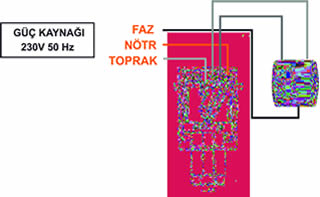 |
Please specify the position and direction of the motor when ordering. Due to the motor mechanism, the first slat starts 49 mm from the very beginning. For guaranteed installation of the motor, please consult Maviperde technical support. |
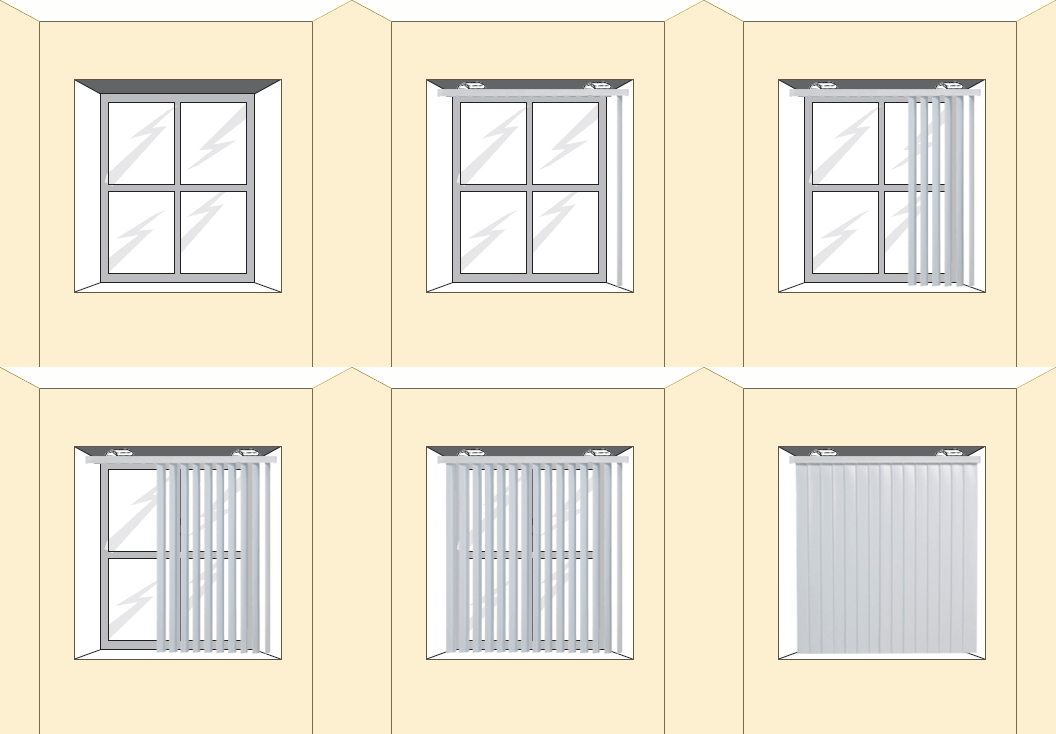
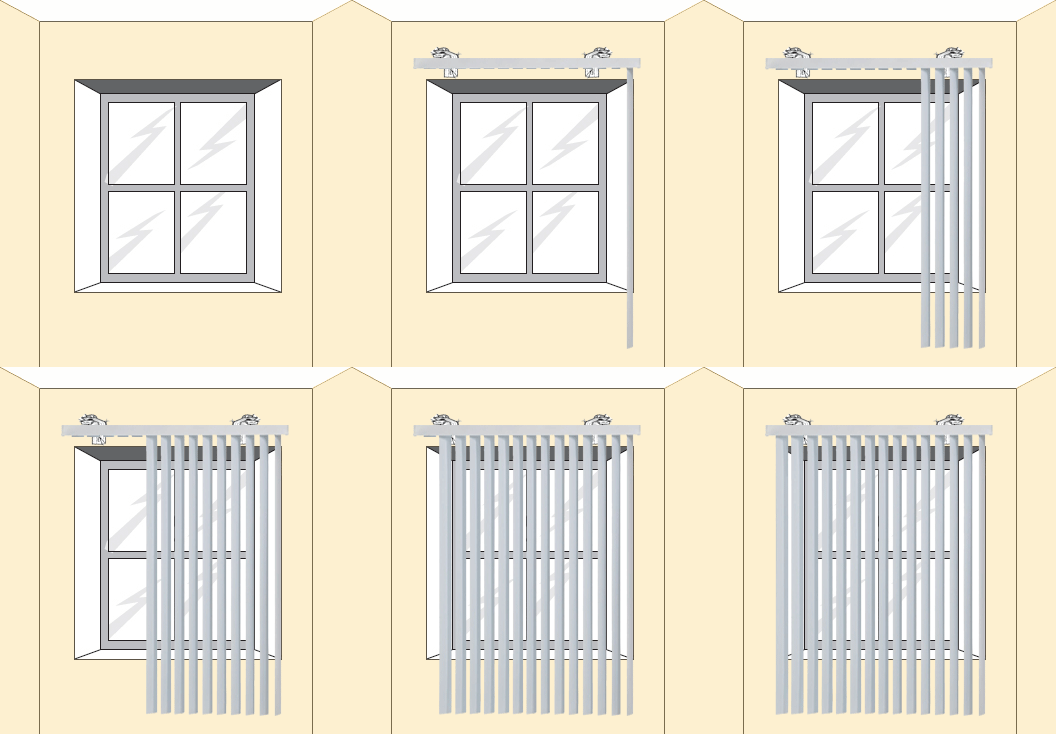
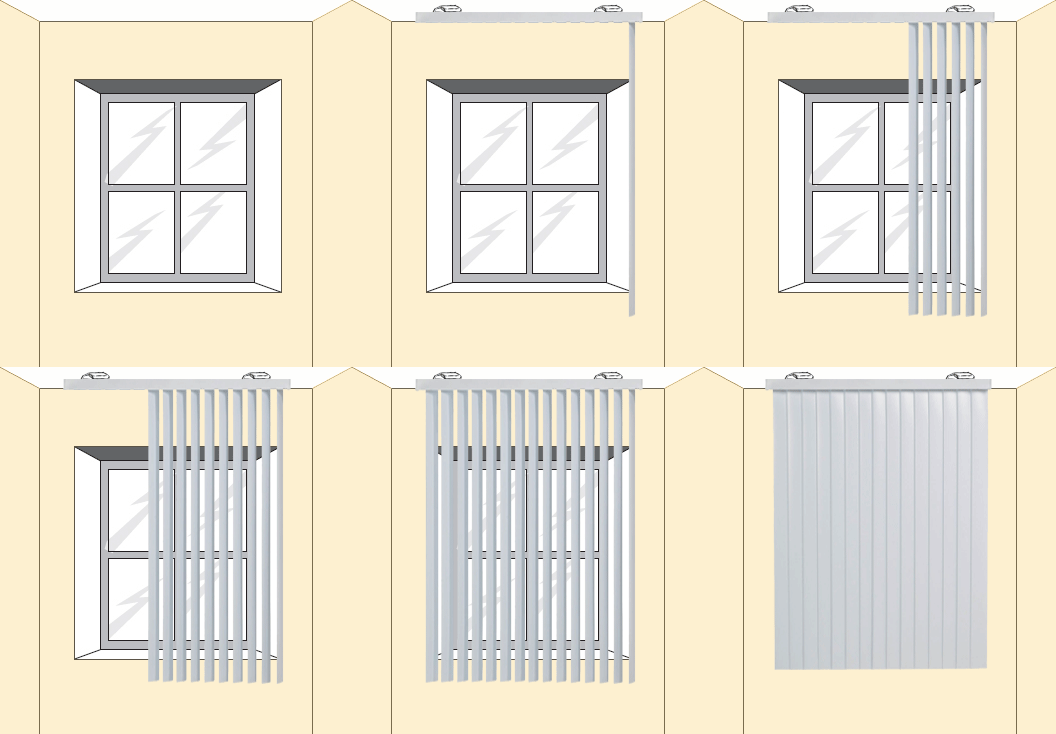
Vertical Blind Mounting Methods
| INSIDE RECESS MOUNT | OVER WINDOW MOUNT | CEILING MOUNT |
 |
 |
 |












Reviews
Clear filtersThere are no reviews yet.